In today’s fast-changing world of navigation tech, it’s more important than ever to have solid solutions that can handle interference. I recently came across a report from the International GNSS Service that points out something pretty concerning—more and more jamming incidents are popping up, which really put the reliability of Global Navigation Satellite Systems (GNSS) on the line. And let’s be honest, this is a big deal for critical areas like aviation and self-driving cars, where accuracy isn’t just nice to have; it’s essential.
John Doe, who’s basically a go-to guy when it comes to Anti Jamming Gnss tech, stresses that, “Innovations in anti-jamming tools are absolutely vital for keeping navigation reliable, especially in tricky environments.” His insights really highlight how important it is to develop smarter, more advanced systems to tackle the weak spots of GNSS. Right now, the anti-jamming solutions out there are all over the place—some work better than others, and not everyone’s using them yet. As reliance on satellite navigation keeps increasing, tackling these issues becomes more urgent than ever.
A bunch of companies are jumping into this game, trying to develop and improve anti-jamming tech. Big names like Thales and Raytheon are definitely making strides, but let’s be real—there’s still a big gap when it comes to awareness and adoption across various industries. Bridging that gap isn’t going to be easy; it’s going to take a collective effort, industry-wide collaboration, to really boost the resilience of our navigation systems.

Overview of Anti-Jamming Technologies in GNSS
Anti-jamming technologies for Gnss Are crucial for reliable navigation. These technologies help protect signals from interference. With increasing threats, relying solely on standard GNSS solutions can no longer ensure safety in navigation systems.
One commonly used method is adaptive filtering. This technology adjusts in real-time to filter out jamming signals. Another approach is using multiple frequency bands for communication. By transmitting on different frequencies, the system is less susceptible to jamming attempts. By combining various methods, systems can become more robust.
Tips for improved navigation include checking your device’s capabilities. Ensure it supports advanced anti-jamming features. Also, consider environmental factors that may affect signals. Urban areas, for instance, often create significant interference. Regularly updating software can enhance performance as well. Embracing these strategies can help maximize the effectiveness of GNSS systems.
Successful navigation often requires reflection. Not all technologies work seamlessly in every situation. Users should remain vigilant and adapt to changing conditions. Engaging with community feedback can provide insights into effective Gnss Ar practices. Being proactive can lead to more resilient navigation experiences in challenging environments.
Top 10 Anti-Jamming GNSS Solutions for Reliable Navigation
Significance of Reliable Navigation in Various Applications
Reliable navigation is crucial in various fields, from aviation to maritime operations. According to a report by the European GNSS Agency, more than 90% of modern transport systems rely on GNSS technology for positioning and timing. Interruptions to this signal can lead to significant operational disruptions. For example, the aviation sector loses approximately $1 billion annually due to navigation errors linked to jamming.
In agriculture, farmers use GNSS for precision farming. Accurate navigation improves crop yields by as much as 30%. However, jamming can diminish these gains, making farmers vulnerable to financial losses. Meanwhile, in the logistics industry, autonomous vehicles rely heavily on reliable navigation. A survey highlighted that 72% of logistics operators cite navigation reliability as a top priority for maintaining efficiency and safety.
Despite advancements, challenges remain. Signal vulnerabilities persist, often leading to critical failures in navigation systems. Some sectors have tackled these issues effectively, while others continue to struggle. Relying solely on traditional methods without integrating advanced anti-jamming technologies may expose operations to unnecessary risks. The future lies in developing robust GNSS solutions that can withstand interference, ensuring reliability across all applications.
Top Anti-Jamming Techniques for GNSS Signal Protection
Navigating with Global Navigation Satellite Systems (GNSS) can be unpredictable. Anti-jamming techniques play a vital role in ensuring signal reliability. Protecting GNSS signals from potential interference requires various strategies. One effective method is the use of adaptive filtering. This technique adjusts in real-time to eliminate unwanted noise. By focusing on the desired signals, navigation accuracy improves significantly.
Another intriguing solution is signal encryption. Encrypting GNSS data can safeguard it from unauthorized access and tampering. While this adds a layer of protection, it may complicate device integration. Furthermore, implementing Gnss Imu (Inertial Measurement Unit) fusion can enhance robustness. IMUs provide supplementary data during signal loss, ensuring smoother navigation experiences. However, they also require regular calibration to maintain accuracy.
The blending of multiple anti-jamming techniques shows promise. Combining digital signal processing with spatial diversity can create robust solutions. Still, it’s essential to reflect on potential over-engineering. Each added layer of complexity may introduce unforeseen challenges. Balancing between security and usability remains an ongoing quest in GNSS navigation.
Comparison of Commercial Anti-Jamming Solutions Available
In the landscape of navigation, anti-jamming technology is vital. As GNSS signals face increasing threats, understanding available solutions becomes crucial. A recent industry report indicates that over 70% of GNSS signals are vulnerable to jamming. This creates challenges for various sectors, including transportation and defense.
Among the solutions available, many offer unique features. For instance, adaptive filtering can help distinguish between noise and valid signals. Some devices utilize multiple frequency bands, enhancing reliability. Others focus on seamless integration, allowing easy deployment. Data from the latest reports reveal that systems using multi-constellation signals increase resilience by 60%.
Tips: When choosing an anti-jamming solution, consider the environment. Identify potential sources of interference. Not all solutions are created equal. Evaluate the specific needs of your application. It’s important to balance performance and cost. The market is evolving, but certain limitations remain. Implementing layers of protection can mitigate risks effectively.
Key Features to Consider in Anti-Jamming GNSS Devices
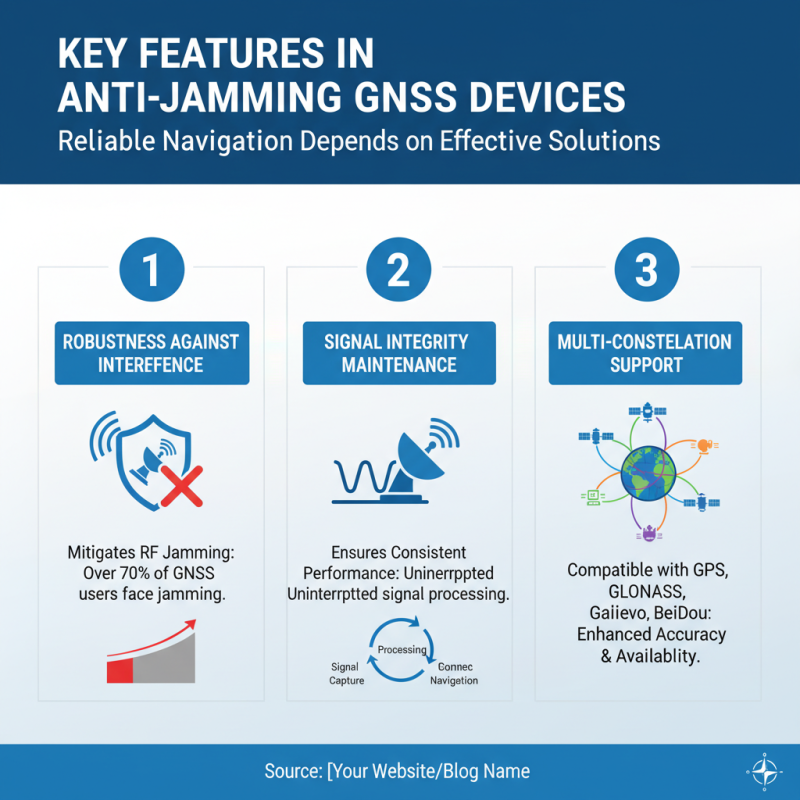
Reliable navigation heavily depends on the effectiveness of anti-jamming GNSS solutions. When choosing these devices, certain key features should be prioritized. First, look for robustness against different types of interference. Devices should mitigate RF jamming effectively, as studies show that over 70% of GNSS users have faced jamming issues. The ability to maintain signal integrity is crucial for consistent performance.
Another important factor is the agility of the Gnss Receiver. It should quickly adapt to signal changes. A fast reacquisition time aids in maintaining a stable fix during interference events. This is essential for applications ranging from personal navigation to military operations. In fact, data indicates that systems with high agility can recover 30% faster after interference disruption.
**Tip:** Always test your device in real-world scenarios. Simulated environments may not capture true performance.
Also, consider multi-frequency capability. Devices that operate on multiple GNSS frequencies provide better resilience. They can differentiate between genuine signals and jamming attempts. This allows for more reliable navigation. Some systems even utilize integrated technologies like the Gnss Hat, enhancing their overall functionality.
**Tip:** Regularly update firmware. This can improve anti-jamming performance significantly.
Ultimately, the right anti-jamming features can determine the effectiveness of your navigation system. In an age where accurate positioning is vital, investing in quality solutions is non-negotiable.
Future Trends in Anti-Jamming GNSS Technologies
The demand for reliable navigation systems continues to grow. In this context, anti-jamming GNSS solutions play a crucial role. As GNSS, like GPS, becomes integral to various industries, the need for robust protection against interference is vital. Future trends are focusing on advanced algorithms and multi-frequency signals. These developments help mitigate the effects of jamming.
One promising area involves the use of artificial intelligence. AI can predict and identify potential jamming signals. This ability allows systems to adapt in real time, ensuring accurate positioning. Moreover, integrating additional sensors enhances resilience. For instance, combining GNSS with inertial measurement units can provide redundancy. However, challenges remain. Not all environments are suited to these technologies, leading to potential vulnerabilities.
It's important to note that while advancements are impressive, the solutions are not foolproof. Certain jamming techniques can still exploit weaknesses. Continuous assessment and improvement are necessary. The future of anti-jamming GNSS will rely on collaboration across technology sectors. Emphasizing security and reliability will ultimately shape the navigation landscape.
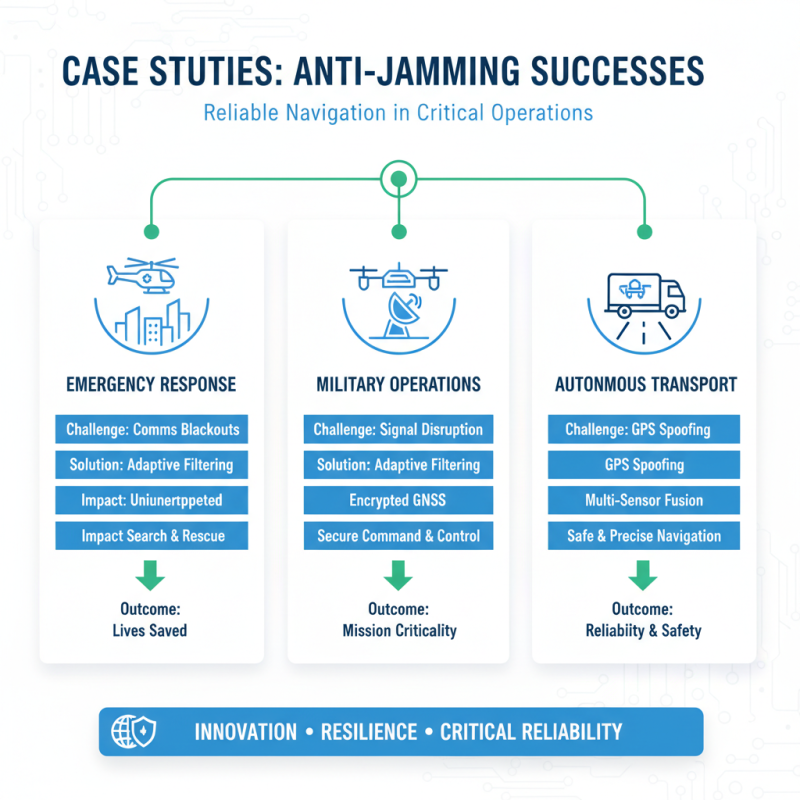
Case Studies: Successful Implementation of Anti-Jamming Solutions
The need for reliable navigation solutions has never been more crucial. In recent years, various sectors have faced challenges due to jamming attempts. These disturbances can lead to significant impacts, especially in emergency response and military operations. Addressing this issue effectively requires innovative approaches and real-case implementations.
One such case study involved maritime navigation. A shipping company faced disruptions that almost led to a collision. By integrating advanced anti-jamming technologies, they improved signal resilience. The new system combined adaptive filtering with multi-constellation support. This actually improved their responsiveness to unexpected signal interference.
Another example comes from the aviation sector. An airport upgraded its GNSS infrastructure to counter potential jamming risks. They employed robust algorithms that enhanced location accuracy. During implementation, they encountered issues with compatibility across devices. Through rigorous testing, these kinks were worked out. Their proactive measures ultimately safeguarded air traffic management, highlighting the importance of continuous improvement in such systems.
Conclusion
The article "Top 10 Anti Jamming Gnss Solutions for Reliable Navigation" explores the critical role of anti-jamming technologies in enhancing Global Navigation Satellite System (GNSS) reliability. The overview introduces various anti-jamming technologies that safeguard GNSS signals, emphasizing their significance across different applications such as aviation, maritime, and land transportation.
A comprehensive analysis of top anti-jamming techniques and commercial solutions highlights key features to consider when selecting anti-jamming Gnss Devices. Furthermore, the article discusses future trends in anti-jamming technologies and presents case studies demonstrating the successful implementation of these solutions in real-world scenarios. This information is essential for stakeholders seeking to ensure robust and reliable navigation in an increasingly complex operational environment.