








What are the components of GNSS ?
Whether we are surveyors or ordinary users, we rely on GNSS (Global Navigation Satellite System) such as GPS and BDS in our daily lives. As a professional Gnss Receiver manufacturer, APEKS is dedicated to designing and producing high-performance GNSS hardware that enables accurate positioning, navigation, and timing across a wide range of applications. A global navigation satellite system consists of three parts: ground control centers, space satellite constellations, and ground user equipment. Among these, the ground user equipment is closely related to our daily lives.
The global satellite navigation system consists of three parts: ground control, space satellite constellation and ground user equipment. The ground user part is closely related to our daily life.
1. Space segment (satellite constellation)
Global Navigation Satellite System space satellites generally operate in a space of about 20,000 kilometers above the ground . They are composed of 24 or 30 satellites distributed on 3 or 6 orbital planes. To ensure the continuous operation of the system, backup satellites are usually configured on each orbit. Backup satellites refer to satellite satellites configured for the reliability and continuity of the satellite system. They are used to quickly replace tasks when the main satellite fails to ensure uninterrupted service.
These satellite constellations form the foundation of positioning services.Apeks Gnss receivers are designed to track multiple constellations, including GPS, GLONASS, BDS, and Galileo, ensuring stable and accurate positioning even in challenging environments.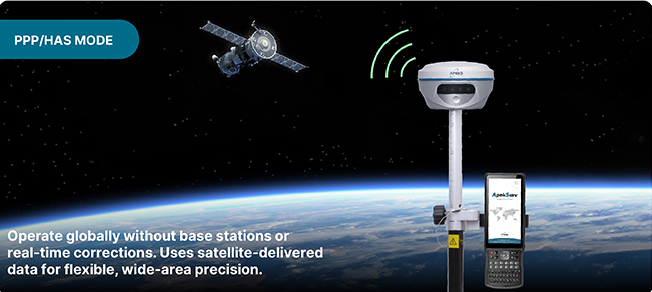
2. Ground control segment (monitoring and maintenance)
1. It consists of a main control station, a monitoring station, a ground antenna, and a communication auxiliary system (data transmission).
2. Main control station: comprehensively manages and coordinates the entire system, formulates system operation strategies and controls , collects, processes and analyzes the data plans of each monitoring station, accurately calculates satellite orbit parameters, clock deviation and other key information, and provides basic data support for positioning services.
3.Monitoring stations: Distributed around the world, they receive satellite signals and collect observation data such as the alpha distance and carrier phase of the monitoring satellite, as well as auxiliary information such as local meteorological data. They monitor the signal quality, visibility and health of satellites in real time, and transmit data to the master control station to evaluate the system performance of the station and perform fault diagnosis.
The master control station and the monitoring station cooperate with each other. The monitoring station provides data support to the master control station, and the master control station makes decisions and controls based on these monitoring data, thereby ensuring the accuracy and reliability of GNSS and providing users with high-quality navigation and positioning services.
The collaboration between control stations ensures the accuracy and reliability of GNSS systems.
Building on this infrastructure, APEKS integrates advanced RTK algorithms and correction technologies into its GNSS products, enabling users to achieve centimeter-level positioning accuracy in real-time applications.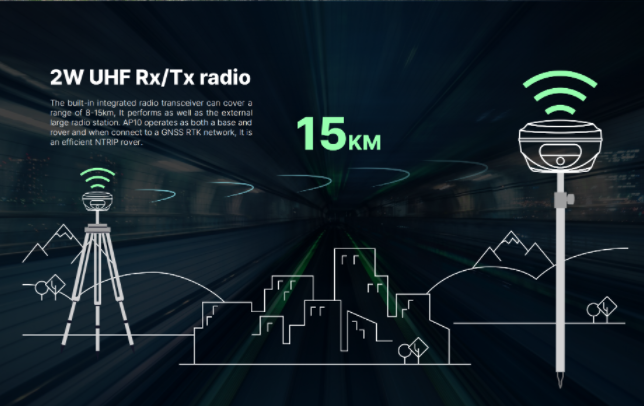
3. User segment (receiving device)
Ground user equipment refers to equipment that can receive and process global navigation satellite system signals to achieve positioning, navigation, timing and other functions.
In theory, it is a bit complicated, but in practice, it will feel very familiar. There are many types of satellite signal receivers, including airborne navigation receivers used in aerospace, aviation, and navigation, measurement receivers for heading positioning, and satellite and handheld receivers used by the general public.
At present, the most common satellite navigation systems in the world include: GPS of the United States, GLONASS of Russia, BDS of China and Galileo of the European Union, as well as QZSS of Japan and IRNSS of India. All of these systems are supported by our Gnss Equipment.
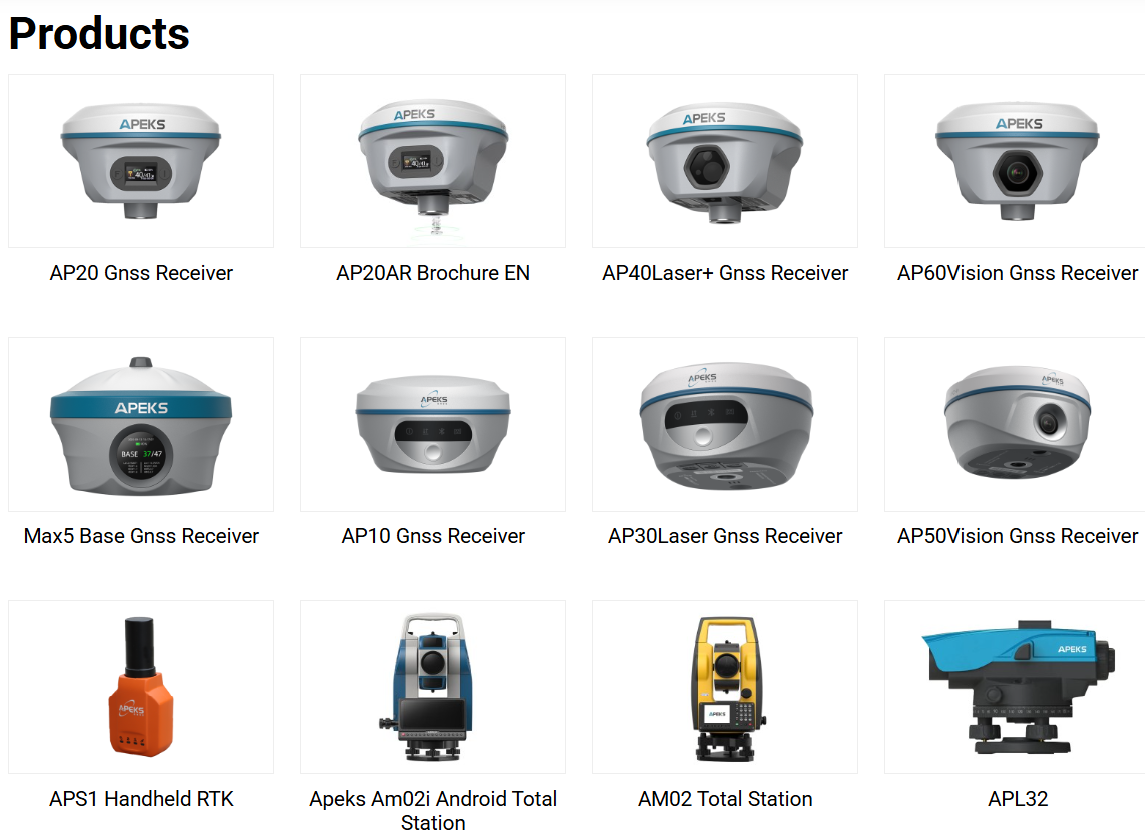
As a professional GNSS receiver manufacturer, APEKS offers a comprehensive range of GNSS equipment, including:
1.Standard high-Precision Rtk receivers——APEKS AP10, AP20, AP20AR, MAX5 (super base station)
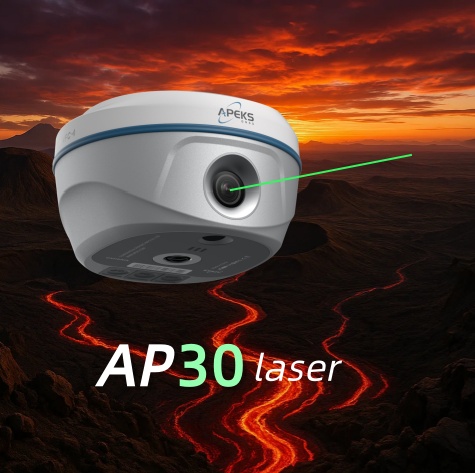
2.Laser RTK receivers——APEKS AP30 laser, AP40 laser+ (120m laser)
3.Imaging GNSS receivers——APEKS AP50 vision, AP60vision
4.Total stations —— APEKS AM02,APEKS AM02i (Android total station)
5.Handheld RTK receivers ——APEKS APS1
These products are widely used in industries such as construction, agriculture, and geospatial surveying, providing reliable and efficient positioning solutions.
Thanks to the cooperation of multiple GNSS components, centimeter-level positioning accuracy can be achieved.
With continuous innovation in GNSS technology, APEKS is committed to delivering high-performance positioning solutions that empower industries such as surveying, precision agriculture, and machine control.
GNSS is gradually transforming our world—and APEKS is proud to be part of this transformation.